Sud Heritage
CALABRIA AND WORK
Ten Calabrian company museums. Ten business histories documented and narrated by departing from old and new stereotypes and, at the same time, avoiding the rhetoric of the “South that works.” Not narratives, but real stories, substantiated by tools, machinery, artifacts, and projects, and supported by finished products, catalogues, documents, and archives recovered, saved from oblivion, preserved, and organized for public access. Calabria, contrary to what many (too many) clichés would suggest, preserves evidence of a widespread culture of work across the territory, with a manufacturing and agri-food profile that is far from negligible. Many companies have succeeded, through careful innovation, in reconciling tradition with long-term competitiveness.
In some cases, they have become “noble faces” not only of Calabria but of Southern Italy as a whole, some having already surpassed centuries of uninterrupted productive activity.
These stories help demonstrate how misleading the clichés are that frame the region solely as a vast, unresolved problem, rather than also as a living and vibrant—yet unjustly overlooked—part of the country as a whole.
Calabria is a complex land. It cannot be reduced to a simplistic paradigm of critical area or failed development, without losing sight of serious problems, structural weaknesses, social hardship, the pervasive and suffocating presence of the criminal power of the ’Ndrangheta, and political and institutional delays in the modernization of administrative and social systems. Company museums reveal another story—one often ignored and sometimes denied. They testify to a Calabria shaped by enterprising and courageous women and men who have created value and employment, innovation and prosperity enduring over time. Stories rich in manufacturing, artisanal, and “industrial” pride. Mostly family-based histories, deeply rooted in their territories of origin, even when they have conquered niche markets nationally and internationally.
By visiting these ten company museums, one tangibly encounters another Calabrian identity—one that challenges false impressions and prejudices, both negative (even deeply negative) and those, equally misleading, steeped in romanticism that depict the region as a pure, uncontaminated zone, a peninsula “happily spared” from processes of modernization. Entering Calabrian company museums and removing monochromatic lenses, one discovers testimonies that dismantle deeply rooted assumptions, such as the supposed unified hostility of the southern aristocracy toward modernity.
The Amarelli family disproves this notion. Their epic began around the year 1000 and continued through participation in the Crusades, cultural engagement, and agriculture. A decisive turning point in manufacturing came in the early eighteenth century with the establishment of a “Concio,” a proto-industrial plant founded in 1731 for extracting juice from licorice roots harvested on their lands. Over the past three centuries—as documented by their company museum (redesigned in 2017 and the most visited in Southern Italy, second nationally only to Ferrari’s museum in Maranello)—they have preserved the innovative and modern drive of their beginnings. Alongside product quality, Amarelli has invested in marketing and communication, as evidenced by their small, elegant cult tin boxes, appreciated also for waste reduction—a virtuous practice from the past that has fostered a form of collecting with vintage graphics and limited editions.
Other company museums undermine yet another stereotype: that of a Calabria eternally isolated, inward-looking, and closed within its hinterland. Callipo 1913, among the first companies in Italy to can prized bluefin tuna, successfully inherited and enhanced a millennia-old local maritime tradition—that of tuna traps and tuna fishermen. Remaining rooted in the Vibonese–Lamezia Tyrrhenian coast, historically one of Italy’s most important tuna-fishing hubs with ten fixed trap systems, the company has also profoundly renewed production, transforming canned tuna into a gourmet product and introducing glass jars.
In the Cosenza area, Gias 1970—the Calabrian company that revolutionized the frozen food market by patenting the method for freezing peeled tomatoes (a true breakthrough for the Italian industry)—has intertwined its corporate history with contemporary painting and sculpture. In their “Gias Experience” museum, alongside historical archives and early machinery, visitors encounter an important art collection. The company has also launched artist and designer residency programs, hosting works within production spaces and promoting workshops open to the local community.
In Soveria Mannelli, the Lanificio Leo 1873 Museum, a protagonist in the economic and productive history of one of the Silan inland territories, not only displays centuries-old machinery from the entire textile cycle (from raw wool to finished fabric), still fully operational, but also serves as a highly active laboratory of “polytechnic culture” and artistic experimentation. Embedded in national and international contexts at the forefront of architecture and industrial design, it pays particular attention to digital technologies. Through constant multidisciplinary relationships, the museum has consolidated itself as a significant “innovative platform.”
Likewise oriented toward future scenarios is Vi.te.s., the company museum of Librandi, a leading force in the revival of regional enology. While the past—even the distant past—is testified by precious artifacts, tools, and a centuries-old built-in wine press at the museum’s core, Vi.te.s. soon became a point of connection between the company and society, actively envisioning trajectories of learning and innovation. Present and future vineyards and wines must confront climate change and soil health. The museum thus becomes a critical space to rethink—together with the local wine community—techniques once considered obsolete: from the recovery of manual skills and traditional agricultural practices to the “philosophy” of old tools long abandoned.
What is underway, in short, is a rediscovery of the past that is not nostalgic but conscious, aimed at addressing contemporary challenges in a sustainable and “natural” way.
In the heart of the Sila Greca, Longobucco today has just over two thousand inhabitants, yet remains one of the historic “capitals” of weaving in Southern Italy. This is testified by the “Eugenio Celestino” Company Museum. Founded in 1959, it inherits the legacy of ideas, courage, and vision of Eugenio Celestino. Now run by his grandchildren Eugenio and Barbara Celestino, the museum is organized into sections dedicated to broom, wool, and silk. Silk, in particular, deeply marked Calabria between the High and Late Middle Ages and during the splendor of the sixteenth century—when Calabria, another “forgotten story,” was a key node along the Silk Road. In 1519, Charles V established regulations for textile and commercial activities in Catanzaro. The high quality and substantial production of Calabrian silk—attracting major Florentine merchant-banking families—made the region a crucial hub of a new Silk Road, foreshadowing proto-capitalist modes of production.
Another distinctive Calabrian product is bergamot, an exotic citrus fruit that took root in the Reggio area. Although cultivated in South America, North Africa, and Sicily, Calabria—particularly the Reggio area—is the world leader in high-quality bergamot. The fruit and its unique cultivation and processing are the focus of the museum conceived and created by Professor Vittorio Caminiti. His passionate research resulted not only in a precious collection of tools, machinery, instruments, and documents saved from oblivion, but also in an active cultural, scientific, and emotional hub. The museum recounts both the centuries-old use of bergamot essence in high-end perfumery and its new “green” frontier in food, pharmaceuticals, cholesterol-lowering beverages, liqueurs, and the kitchens of leading chefs.
Then there is Calabrian bread. Like many other foods, it seems defined by a uniqueness that is only apparent. “Calabrian bread,” paradoxically, does not exist as a single entity. It appears in countless forms, flour compositions, colors, flavors, and aromas, with hundreds of varieties baked in different towns, hamlets, and villages across the region. The Pane di Cuti Museum is a treasure chest of material history, encompassing social, economic, and anthropological dimensions. For seven years it has also functioned as a cultural space hosting events, book presentations, and exhibitions, while offering visitors an interactive, emotional experience in the bakery laboratory—allowing them to become “bakers for a day.”
Editorial and printing activities also challenge stereotypes about Calabria. Who would imagine that in 1475—just twenty-five years after Johannes Gutenberg’s invention—the first Hebrew Bible was printed in Reggio Calabria, in the workshop of printer Abraham ben Garton? For over fifty years, the publishing and printing activities of Rubbettino have continued the millennia-long relationship between Calabria and paper. This story is told through the CARTA company museum, adjacent to the publishing house and printing plant in Soveria Mannelli. The museum covers the history of the book, printing processes and techniques, paper and typographic materials, up to digital technologies. It also includes a contemporary art park featuring significant works linking the vegetal world with that of the company through the nexus of cellulose–paper–publishing–printing. The exhibition path merges with a laboratory of creativity, design, innovation, and experimentation, open to innovators in communication, design, and digital craftsmanship.
The story told by the Terme Caronte Museum in Lamezia Terme is inseparable from the family history of the Cataldi family, an entrepreneurial dynasty that has passed leadership through ten generations since 1716. Their company museum narrates a long-standing commitment to civil progress and the evolution of thermalism. In a place frequented for millennia for its extraordinary sulfurous hot waters—attested by important archaeological remains—Terme Caronte renews its commitment to health and well-being.
The ten museums in the network—all companies fully active—constitute a Grand Tour into the heart of innovation: a journey in which history, creativity, and vision intertwine. They can only be places of the future. As Salvatore Settis has noted, company museums are “theatres of memory”: they stage what has been done and what will come. They are living places of memories, testimonies, tools, study, and work—cultural junctions within the world of enterprise, rooted in territory and vocation, capable of expressing beauty, quality of production, and technical expertise.
Places that look forward, with their gaze directed beyond local and national borders.
Gianfranco Manfredi
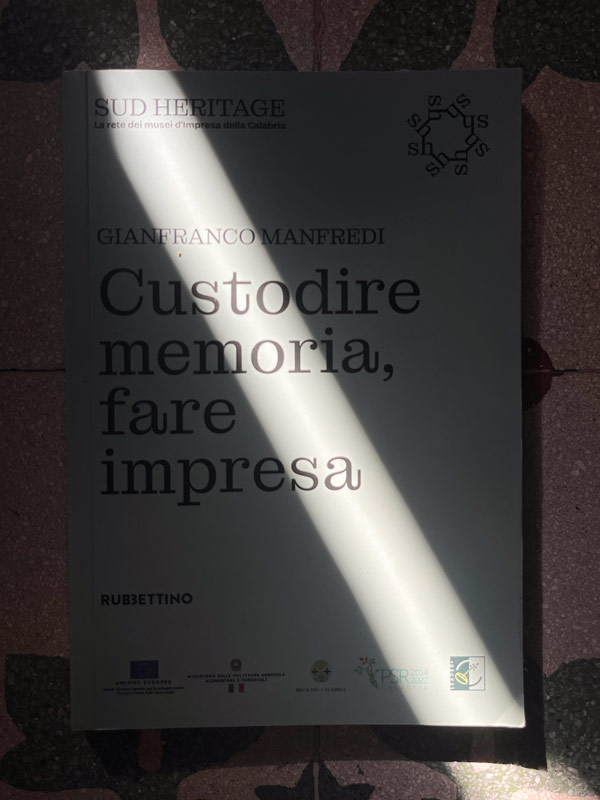
Custodire Memoria, fare impresa
Gianfranco Manfredi
ISBN 9788849887624


